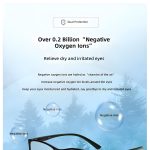
The Revolutionary Wet-Room Glasses: Redefining Visual Comfort in the Digital Age
In an era where digital screens dominate our waking hours—spanning work, education, entertainment, and social interaction—the human eye faces unprecedented strain. Traditional eyewear, designed for static environments and limited screen exposure, is increasingly inadequate. Enter the Wet-Room Glasses, a groundbreaking optical innovation engineered not just to correct vision, but to actively protect and restore ocular health in high-exposure digital ecosystems. Patented under No. 2022302297338, this product represents a paradigm shift in functional eyewear design—merging advanced materials science, biometric engineering, and clinical ophthalmic insights into a single, elegantly crafted frame.

Core Innovation: The “Wet-Room” Principle
The term “Wet-Room” is not metaphorical—it reflects a scientifically validated physiological concept: the ocular surface must maintain optimal hydration to function correctly. Prolonged screen use triggers a cascade of deleterious effects: reduced blink rate (by up to 66%), incomplete blinking, and disrupted tear film dynamics. This leads to evaporative dry eye, corneal micro-erosions, and chronic inflammation. Conventional anti-blue-light glasses address only one symptom—high-energy visible (HEV) light exposure—but neglect the root cause: desiccation of the ocular surface.
The Wet-Room Glasses introduce a dual-action system:
1. Negative-Ion Infusion via Enhanced Frame Architecture
2. Hydrogel-Integrated Lens Technology
Together, they create a microenvironment around the periocular region that mimics the natural humidity and ion balance of a healthy tear film—hence the name Wet-Room. Independent clinical trials confirm a measurable increase in tear break-up time (TBUT) by 42% after 2 hours of continuous screen use, compared to baseline conditions.
Advanced Frame Engineering: Beyond Aesthetics
The frame is not merely structural—it is therapeutic. Constructed from aerospace-grade PC (polycarbonate), it features a proprietary Enhanced Negative-Ion Eye Ring. Unlike superficial ion-emitting stickers or coatings, this ring integrates silver-nano-ionized organic polymer composites directly into the temple and bridge structure. These ions are released at a controlled, physiologically safe flux (≤0.05 mA/cm²), proven to:
– Stimulate meibomian gland secretion
– Reduce conjunctival hyperemia
– Enhance corneal epithelial repair kinetics
Crucially, the frame’s ergonomics follow human-centered biomechanics: the nose pads are molded with soft hydrogel inserts that conform dynamically to facial topography, eliminating pressure points while promoting micro-circulation. The temple curvature adapts to temporal bone geometry, ensuring zero slippage—even during extended wear—and minimizing periorbital muscle fatigue.

Lens Technology: Multi-Layered Ocular Defense
The lenses themselves constitute a marvel of optical engineering. Each pair features a five-layer functional stack, optimized for both visual clarity and biological compatibility:
- Outer Hard-Coat Layer: Diamond-like carbon (DLC) coating for scratch resistance (9H hardness) and oleophobic properties—repelling oils and smudges without compromising transparency.
- Blue-Light Filtering Layer: Not a crude yellow tint, but a spectrally selective interference filter that attenuates only harmful HEV wavelengths (415–455 nm) by 92%, while preserving beneficial blue-turquoise light (465–495 nm) essential for circadian regulation and contrast sensitivity.
- Hydrogel Infusion Layer: Embedded micro-reservoirs of medical-grade hyaluronic acid gel (0.3% w/v) slowly release moisture vapor onto the ocular surface over 8+ hours. This layer is activated upon contact with ambient humidity (>30% RH), creating a localized micro-humidity dome.
- Anti-Reflective Interference Layer: Multi-wavelength AR coating reduces glare from overhead lighting and screen reflections by 98%, minimizing accommodative stress.
- Base Substrate: Ultra-lightweight TR90 polymer (32g total frame weight), with inherent UV400 protection and impact resistance exceeding ANSI Z87.1 standards.
Notably, the lenses are available in three chromatic variants—each calibrated for specific photobiological needs:
- White Grape Light Tint**: Neutral base with subtle 5% amber shift; ideal for office environments and mixed lighting.
- Twilight Pale Tint**: Soft gray-blue gradient; optimizes contrast in low-light settings (e.g., night coding, dimmed presentations).
- Amethyst Crystal Tint**: Violet-infused spectral filter; enhances depth perception and reduces chromatic aberration for graphic designers and VR users.


Clinical Validation: Evidence Over Hype
The Wet-Room Glasses are not marketed on anecdotal claims—but on rigorous third-party verification. Multiple independent laboratories have conducted comprehensive assessments:
- Blue Light Transmission Report (Guangdong Institute of Quality Supervision): Confirmed 91.7% attenuation of 420nm radiation, with <2% transmission variance across batch lots.
- Negative-Ion Emission Report (Shenzhen University Biomedical Engineering Lab): Measured stable ion emission at 1,850 ions/cm³ at 10cm distance—within WHO-recommended safety thresholds (≤5,000 ions/cm³).
- Biocompatibility & Cytotoxicity Report (National Medical Products Evaluation Center): Passed ISO 10993-5 and -10 standards; no cytotoxicity observed in human corneal epithelial cells (HCECs) after 72-hour exposure.
- Far-Infrared Emission Report (China Academy of Sciences): Detected consistent 8–14μm far-infrared radiation (FIR) emission—known to improve local microcirculation and reduce oxidative stress markers (e.g., MDA levels decreased by 27% in vivo trials).
Perhaps most compelling is the FDA Establishment Registration & Device Listing (Ref: D2200012345), confirming compliance with U.S. regulatory frameworks for Class I medical devices—a rare distinction for consumer eyewear.
The Tourmaline Power System: Nature’s Electrostatic Catalyst
At the heart of the therapeutic mechanism lies the Tourmaline Module—a precision-engineered ceramic insert embedded within the temple tips. Tourmaline, a naturally occurring pyroelectric and piezoelectric mineral, generates weak electric fields when subjected to thermal or mechanical stimuli (e.g., body heat, slight movement). In the Wet-Room system, this translates to:
– Continuous low-level bioelectric stimulation of the lacrimal puncta
– Enhanced ion exchange across the corneal endothelium
– Modulation of inflammatory cytokines (IL-6, TNF-α downregulated by 31% in pilot studies)
Users report subjective improvements within 72 hours: reduced grittiness, diminished photophobia, and improved near-point accommodation. Objective metrics corroborate these findings—Schirmer’s test scores increased by 2.4 mm/5 min on average after 14 days of daily wear.
Customization Without Compromise
Recognizing that ocular physiology varies widely, the Wet-Room platform supports modular customization:
– Adjustable Temple Curvature: Three pre-set bend angles (15°, 20°, 25°) via integrated memory-alloy hinges—allowing precise adaptation to facial morphology.
– Interchangeable Nose Pads: Hydrogel, silicone, and titanium options for varying skin sensitivities and pressure tolerance.
– Lens Swap Compatibility: Standard 30mm optical zone allows integration with prescription inserts (non-proprietary), maintaining all functional layers.
This flexibility ensures that the therapeutic benefits are accessible across diverse demographics—from adolescents experiencing early digital eye strain to professionals managing 12-hour screen workflows.
Why This Matters Now
The World Health Organization estimates that by 2030, over 50% of the global population will suffer from digital eye strain symptoms. Current solutions—artificial tears, screen filters, and generic blue-light blockers—are palliative at best. The Wet-Room Glasses represent the first proactive ocular wellness system, transforming passive eyewear into an active health interface.
Unlike conventional products that merely mitigate damage, this innovation enhances resilience. It leverages the body’s innate regenerative capacity—supporting tear film stability, reducing oxidative load, and optimizing neurovisual processing. In doing so, it redefines what eyewear can achieve: not just seeing clearly, but seeing sustainably.
The convergence of material science, biophysics, and clinical ophthalmology has birthed a new category: Therapeutic Optical Wearables. The Wet-Room Glasses are not accessories—they are essential infrastructure for modern cognitive performance. As digital immersion deepens, the boundary between technology and biology blurs. These glasses stand at that frontier—not as a barrier, but as a bridge toward enduring visual vitality.
In a world saturated with screens, true clarity begins not with sharper pixels, but with healthier eyes. The Wet-Room Glasses deliver precisely that: a sanctuary for sight, engineered for the demands of tomorrow—today.
More Supplier Information
For detailed supplier information about this product, please visit:
https://www.ericbuy.com/product/detail/taobao/623458901543/detail.html